
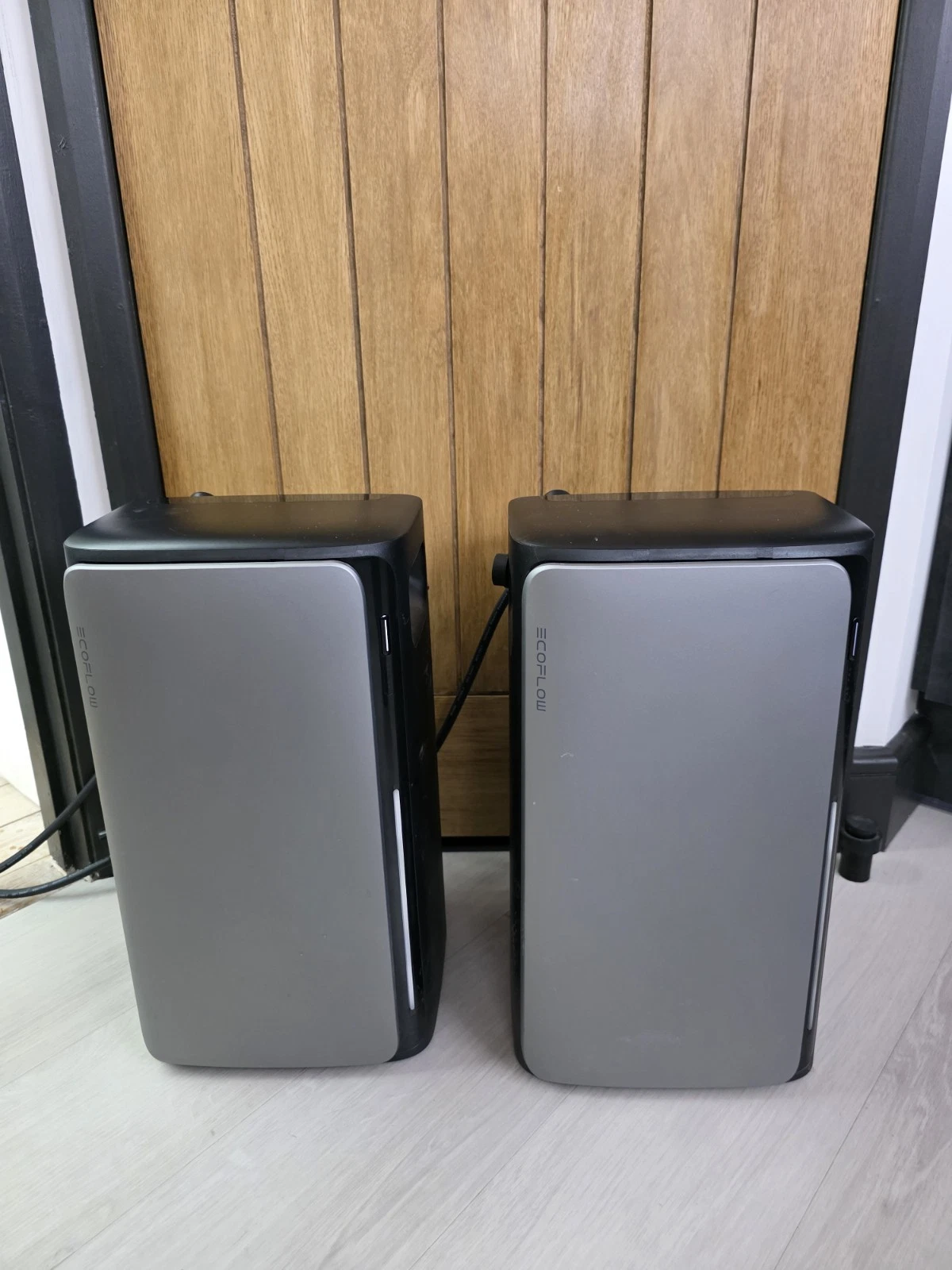
The EcoFlow STREAM series is a family of home batteries designed for plug-in solar. There are six models, and they all store energy, connect to the EcoFlow app, and feed power back into your home. But there’s one big difference that splits the range in two: whether or not the battery has MPPT solar connectors.
"THEY ALL LOOK THE SAME?!?! WHAT IS THE F'ING DIFFERENCE?!?!?!"
Fear not, we've done the legwork.
The Key Difference: Solar Connectors (MPPT)
MPPT stands for Maximum Power Point Tracking — it’s the connector that lets you plug solar panels directly into the battery. If a STREAM battery has MPPT inputs, your panels wire straight in. If it doesn’t, you charge it from the mains grid or via a separate micro-inverter plugged into a wall socket.
This splits the STREAM family into two ranges:
- The Stream range (Ultra X, Ultra, Pro, Max) — has MPPT connectors, so solar panels plug straight in.
- The AC range (AC Pro, AC) — no MPPT connectors. Charged from the grid or via an AC-coupled micro-inverter.
The Stream Range — Solar Panels Plug Straight In
These four batteries all have MPPT inputs, meaning your solar panels connect directly to the battery. The difference between them is how many MPPT inputs they have (i.e. how many panels you can connect) and how much they can expand.

Stream Ultra X
The biggest and newest in the range. It has double the battery capacity of the other models at 3,840 Wh (3.84 kWh), plus 4 MPPT inputs accepting up to 2,000W of solar. It outputs 2,300W — enough to run most household appliances. You can chain up to 6 units together for a massive 23 kWh system. This is the one to pick if you want maximum storage and maximum solar harvest.
Stream Ultra
Same 4 MPPT inputs and 2,000W solar capacity as the Ultra X, but with the standard 1,920 Wh (1.92 kWh) battery. It outputs 1,200W on its own (2,300W when paired). Expandable to 11.52 kWh with 6 units. Choose this if you want the most solar flexibility but don’t need the extra base capacity of the Ultra X.
Stream Pro
The mid-range option. It has 3 MPPT inputs for up to 1,500W of solar, and the same 1,920 Wh battery. Outputs 1,200W (2,300W paired). Expandable to 3.84 kWh with 2 units. A good balance between solar capacity and cost — three panels is enough for most balcony or garden setups.
Stream Max
The entry point for direct solar. It has 2 MPPT inputs for up to 1,000W of solar and the same 1,920 Wh battery. Outputs 1,200W. The most affordable option if you want panels plugging directly into your battery. Ideal if you’re starting with one or two panels and want to keep costs down.
The AC Range — No Direct Solar Connection
These two models have no MPPT connectors. They can’t accept solar panels directly. Instead, they charge from the mains grid or by pairing with a separate STREAM micro-inverter that plugs into a wall socket and feeds solar energy to the battery over AC.

Stream AC Pro
A standalone home battery with no MPPT inputs. It charges from the grid at up to 1,050W, or you can pair it with a STREAM micro-inverter to feed in up to 800W of AC-coupled solar. It has 1,920 Wh of storage and outputs 1,200W with 800W grid feed-in. Expandable to 11.52 kWh with 6 units. This is the best choice if you already have a micro-inverter setup and just want to add battery storage, or if you want to charge cheaply overnight on a time-of-use tariff and use the stored energy during peak hours.
Stream AC
The simplest unit in the family — a pure extension battery. It has no MPPT inputs and no independent AC output. It’s designed to be added to another STREAM unit to increase total storage capacity. It connects with a single AC cable. Choose this when you already have a Stream or AC Pro and just need more kWh.
If you are chaining units together, this is a good "end of the chain" option as it cant chain further batteries beyond it.
Full Comparison
| Model | Battery | MPPT Inputs | Max Solar | AC Output | Expandable To |
|---|---|---|---|---|---|
| Ultra X | 3,840 Wh | 4 | 2,000W | 2,300W | 23 kWh (6 units) |
| Ultra | 1,920 Wh | 4 | 2,000W | 1,200W | 11.52 kWh (6 units) |
| Pro | 1,920 Wh | 3 | 1,500W | 1,200W | 3.84 kWh (2 units) |
| Max | 1,920 Wh | 2 | 1,000W | 1,200W | — |
| AC Pro | 1,920 Wh | 0 | 800W (AC-coupled via a microinverter) | 1,200W | 11.52 kWh (6 units) |
| AC | 1,920 Wh | 0 | — | Standalone/ Extension only | Can be paired with other units but not another AC |
What They All Share
- LFP (LiFePO4) battery chemistry — safer and longer-lasting than lithium-ion
- Up to 6,000 charge cycles with 70% capacity retention
- 10-year warranty
- IP65 weatherproofing — rated for outdoor installation
- Self-heating — operates from −20°C to 55°C
- EcoFlow app — real-time monitoring and control
- AI-powered energy management — learns your usage patterns to optimise when to store and when to discharge
Which One Should You Choose?
Want solar panels plugging directly into the battery? Go with the Stream range (Ultra X, Ultra, Pro, or Max). Pick based on how many panels you have and how much storage you need.
Already have a micro-inverter or just want grid storage? The AC Pro is your best bet — it pairs with your existing setup or charges overnight on cheap rates.
Just need more capacity? Add a Stream AC extension battery to any existing STREAM unit.
Want the absolute maximum? The Ultra X has double the base storage and the most solar input of any model.
Best balance of price and features? The Pro — three MPPT inputs cover most balcony and garden setups without paying for extras you don’t need.