
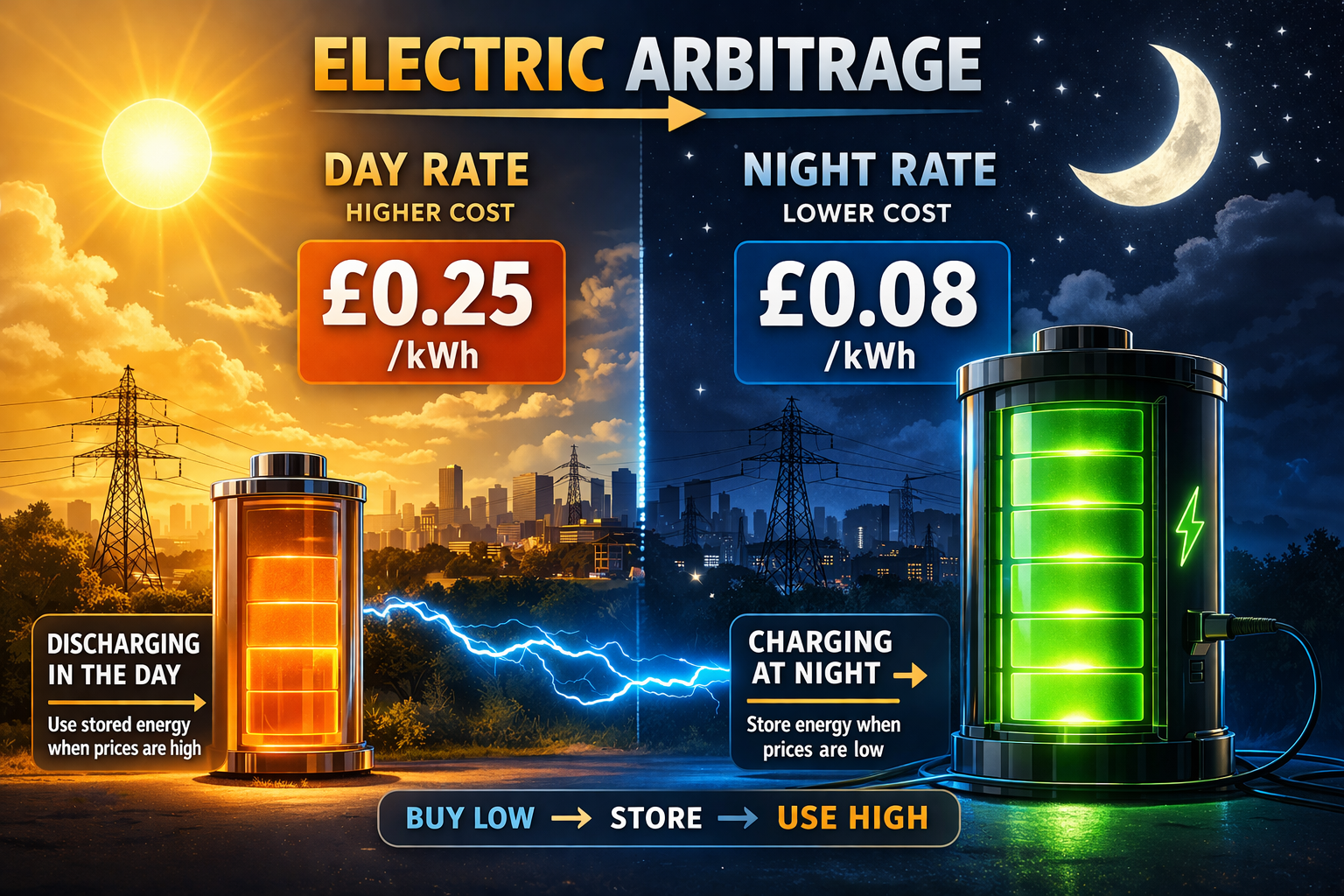
If you are on a time-of-use electricity tariff like Octopus Go, Intelligent Octopus Go, or Octopus Flux, you already know that electricity prices vary dramatically throughout the day. Overnight rates can be as low as 7p/kWh, while peak rates hit 30p+/kWh. That price gap is free money — if you have somewhere to store the cheap electricity.
That is where the EcoFlow STREAM series comes in.
What Is Energy Arbitrage?
Energy arbitrage simply means buying electricity when it is cheap and using it when it is expensive. You charge your STREAM battery overnight at the low rate, then it discharges during the day to power your home instead of drawing from the grid at peak prices.
The maths is straightforward. If you charge a 1.92 kWh battery at 7p/kWh (about 13p total) and use that stored energy instead of buying at 30p/kWh (about 58p total), you save around 44p per cycle. Over a year, that is roughly £160 saved from a single unit — and it scales if you chain more together.
Which STREAM Products Work Best for Arbitrage?
Any STREAM battery can charge from the grid overnight, but some models are better suited to pure arbitrage than others:
- STREAM AC Pro (1,920 Wh) — the ideal arbitrage battery. It charges from the grid at up to 1,050W and feeds up to 800W back into your home. No solar panels needed, though you can pair it with a STREAM micro-inverter later. Expandable to 11.52 kWh with up to 6 units.
- STREAM Ultra X (3,840 Wh) — double the battery capacity of the other models. If you want maximum overnight storage from a single unit, this is it. Four MPPT inputs also mean you can combine arbitrage with direct solar during the day.
- STREAM Ultra / Pro / Max (1,920 Wh each) — all three charge from the grid and have MPPT solar inputs built in. Pick based on how many solar panels you want to connect: Ultra takes 4, Pro takes 3, Max takes 2.
- STREAM AC (1,920 Wh) — a pure extension battery. Chain it onto an AC Pro or any other STREAM unit to increase your total storage capacity.
If you are purely doing overnight arbitrage without solar panels, the AC Pro is the best starting point — it is designed for grid charging and does not include MPPT connectors you will not use, keeping costs down.
Setting Up a Charging Schedule
The EcoFlow app lets you set precise charging schedules. Here is how to configure overnight charging:
Step 1: Check Your Tariff Times
Most time-of-use tariffs have an off-peak window. Common examples:
- Octopus Go: 00:30 – 04:30 (4 hours at 7.5p/kWh)
- Intelligent Octopus Go: 23:30 – 05:30 (6 hours at 7.5p/kWh)
- Octopus Flux: 02:00 – 05:00 (3 hours at a reduced rate)
- Economy 7: typically 7 hours overnight (varies by region)
Step 2: Configure in the EcoFlow App
- Open the EcoFlow app and select your STREAM device.
- Go to Settings > Charging Schedule.
- Set the start time to match the beginning of your off-peak window.
- Set the end time to when off-peak ends.
- Set the charge limit to 100% (or 80% if you want to preserve long-term battery health).
- Enable scheduled charging — the battery will only draw from the grid during your set window.
Step 3: Let It Discharge During Peak Hours
The STREAM batteries automatically feed stored energy back into your home circuit during the day. You can control the output wattage through the app — typically set this to match your base load (200 – 400W) so the energy is consumed by your appliances rather than exported.
How Much Can You Actually Save?
Here is a realistic breakdown based on common STREAM setups:
| Setup | Usable Capacity | Daily Saving | Annual Saving |
|---|---|---|---|
| STREAM AC Pro / Max / Pro / Ultra (single unit) | 1,920 Wh | ~44p | ~£160 |
| STREAM Ultra X (single unit) | 3,840 Wh | ~88p | ~£321 |
| 2x STREAM units | 3,840 Wh | ~88p | ~£321 |
| AC Pro + 5x AC (max chain) | 11,520 Wh | ~£2.65 | ~£967 |
Based on 7p/kWh off-peak vs. 30p/kWh peak, 365 days, 90% round-trip efficiency.
Tips for Getting the Most Out of Arbitrage
- Combine with solar. If you have a STREAM model with MPPT inputs, your panels charge the battery for free during the day. Overnight charging fills any remaining capacity. You get the best of both worlds.
- Match discharge to your base load. Set the output to match what your home constantly draws (fridge, router, standby devices). This ensures every watt is used, not exported.
- Use 80% charge limit for longevity. LFP batteries already last a very long time (up to 10,000 cycles), but keeping the charge limit at 80% extends that even further.
- Monitor with the app. The EcoFlow app tracks charging and discharging in real time. Check your first week of data to fine-tune timing and output levels.
- Consider Octopus Intelligent Go. If you have an EV, Intelligent Octopus Go gives you the longest off-peak window (6 hours), which is plenty of time to fully charge your STREAM batteries.
- Write it off against tax. If you are self-employed or work from home, a STREAM battery doubles as a UPS (uninterruptible power supply) that keeps sensitive equipment like computers, routers, and NAS drives running during a power cut. That means it can potentially be expensed as a business asset and written off against tax. Speak to your accountant, but for many home workers it is a legitimate business expense.
- Chain units for bigger savings. The AC Pro supports up to 6 units in a chain (11.52 kWh total). More capacity means more cheap energy stored and bigger daily savings.
Is It Worth Buying a STREAM Battery Just for Arbitrage?
A single STREAM AC Pro saves around £160/year on arbitrage alone. At current pricing, that is a payback period of roughly 6 – 8 years — and LFP batteries are rated for 10,000+ cycles, so the unit will last well beyond payback.
If you combine a 10% referral discount, TopCashback, and wait for an EcoFlow sale, you can cut the upfront cost by 20 – 30%, bringing the payback down to around 4 – 6 years. And if you add solar panels later, the savings stack on top.
Getting Started
All you need is an EcoFlow STREAM battery, a time-of-use tariff, and 10 minutes in the app. Set it once and the savings accumulate automatically, every single night.
Not on a time-of-use tariff yet? Sign up to Octopus Energy with our referral link to claim a credit on your first bill. Octopus Go and Intelligent Octopus Go are both available once you have a smart meter — Octopus can usually arrange a free smart meter install as part of the switch.